
The Failure of Institutional Design in Virtual Spaces: Problems and Planning
Added 2020-08-02 23:49:35 +0000 UTC
How can a new institution, that is actually useful and sustainable be generated? What design is actually needed? This has been an ongoing problem, but it remains one in desperate need of a solution. Twitter for a long time been used as a collecting ground, or perhaps one should say, a purgatory of sorts. People are drawn to this space, people in possession of different kinds of talent. Talent that is not otherwise developed or utilized by existing institutions, such as academia. The people who gather on Twitter are young, or younger, and they may be searching for alternative communities within which to develop themselves, communities capable of recognizing their potential in a way that they feel traditional institutions have not been able to do.
Many of the issues have already been discussed, such as the question of why institutions are failing to capture this potential. Likewise, having no institution in which to ground yourself takes a psychological toll as well, and the various possible consequences of this kind of systematic failure have also been discussed quite endlessly. These questions therefore are not my concern here.
There is simply no possibility of developing these lines thought to a point where they will be adopted by institutional managers. That is to say, reform is unlikely. In all honestly, reform does not really seem to me to even be desirable. Simply reintegrating the “lost community” into universities, for instance, is not really a worthwhile project, however much the conservative establishment punditry would like to reestablish their influence and control there.
With Twitter, there are few long-term prospects of accomplishing anything. Individuals join the community, they build their connections to it, they experience a sense of belonging they felt they lacked, and from there, they are perhaps encouraged to develop their talents further by the friends they make. The feeling of belonging which is achieved is of a delusive nature, however, and serves only as virtualized substitute for what the individual is actually lacking. The more inured to this imitation the individual becomes, the more dependent upon it, he grows, the more his development is quietly arrested.
It is from my own experience and observation that I draw this conclusion, though it may be a bitter pill for some to swallow. There are some who are content with things, with themselves, and who maintain a healthy sense of detachment from the community. These individuals have no stake in things, and usually already occupy niches within existing institutional spaces. Though they may have sympathy, and may endeavor as best they’re able to assist, they have little stake in the whole matter, and are satisfied with simply watching the undulating flux of the timeline as people come and go.
Others may persist for long periods of time, growing deeply dependent on their online identities and their place within the simulated community. Simply because they endure for so long however does not mean that they will develop throughout the entire duration of the involvement. On the contrary, they are more likely to actually experience a state of arrested development. In the worst-case scenario these individuals tend to come to bad ends. They find themselves exposed, their friends turn on them, they are ritualistically humiliated and cast out in shame.
Those individuals however who achieve some degree of development, however, in contrast to those described above, will likely simply grow increasingly dissatisfied or uninterested the imitation community. Such individuals typically are capable of a higher degree of self-awareness and self-criticism. They also care more about the development of their own abilities, and see in the imitation community a pool of resources and knowledge from which to draw. Thus, they desire more than a group of friends, they desire an intellectual or cultural community of a higher order, and this they will always be disappointed to find does not actually exist in a meaningful way. In the end, the most talented individuals will gradually lose interest, find actualization in their own lives, and simply move on.
In my experience I can say that the loss of this last group which is the worst, as the imitation community does not offer enough to sustain them. These individuals typically are in possession of the highest reserve of potential and talent though, so to lose them through attrition in such a way is the greatest defeat of the entire project. The goal should be entirely to discover such individuals, to recruit them within an institutional framework, and to supercharge their development.
Any notion of doing anything like this, however, is hardly even a pretense anymore. Some ideologues have recently been actively discouraging reading, learning, intellectual cultivation, and even abstract or critical thinking. There is widespread dissatisfaction felt not only by me, but by a number of others as well, who are simply tired of the stagnation of the space and its inability to develop anything worthwhile or lasting. The imitation community has become, instead, a staffing pool for a consolidated group of influencers. Influencers whose only interest lies in ideological and professional competition. Development is not encouraged. Simply organizing around the whims of the faction leader is the only standard of belonging, as he directs you to targets to harass, or signals to boost.
All this perhaps goes without saying, as things have gone on this way for quite some time. The basic challenge of the whole thing remains, however, and the question is, can an institution be erected out of all this to succeed where others have failed?
Matters must be considered carefully, as I too have some experience here, and can comment that it is always easier said than done.
Running a kind of magazine or journal, for instance, achieves nothing, and is difficult and unrewarding. Jacobite magazine is one such example. The editors involved came with real world experience working for established publications. The project continues, it seems, but output is weak. The magazine, despite having access to “top” names like Nick Land, has had minimal impact. There is no vibrancy, no life, nothing. I’m sure, of the tens of thousands of people on Twitter who are the intended audience, very few of those are interested in reading these lengthy essays (unlike you, a sophisticated man of learning reading this right now).
From the standpoint of an editor such projects are difficult to sustain, and here I speak with experience. Firstly, the pool of capable writers is small. Very small. I found I was very quickly disappointed by what people were sending me, and people who talked a big game were largely incapable as writers. Or they were simply unable to say something interesting. Recruiting the writers who were most desirable to me, likewise, entailed constant pestering, and many simply were not interested. Actually getting articles delivered was another whole matter as well, as people simply ended up not getting around to doing what they had pitched, leaving me without articles on my calendar.
Establishing an incentive system capable of keeping people engaged and active in these kinds of projects is very difficult. An online magazine is not likely to ever make any money, and so very little can be offered to writers. This means the consequence a writer faces for not delivering is trivial, the loss of $15, perhaps. The economics simply aren’t workable. What is instead really needed is permanent staffing, where writers are able to make meaningful income they would rather not lose. But anything like this would require substantial investment, and no investor for such a project exists. A niche online magazine? I could go on and on explaining the issues, but I think it’s clear that the whole idea is a dead end.
You can see though, from the above, that any institution here will have work to develop the individuals it recruits, and therefore must function like a school as well as a publication. It’s frankly unlikely to produce some kind of high quality cultural magazine and find an audience for it within the imitation community. And so commissioning writers to produce content for these this audience will likely fall on deaf ears anyway the higher quality it is. Meaning it all ends up being busywork, as the quality of what the writers are mostly able to produce is negligible, and the audience they’re targeting is tasteless and disinclined towards self-development in the first place.
Any institution therefore should function somewhat more like an academy or school, and what is produced should serve some other function than a magazine article does, of being a consumable product. Yarvin first introduced this kind of idea with his notion of an “antiversity”. No one has made any headway towards the establishment of such a thing. Neoreaction I think, generally, considered itself to be the antiversity incarnate, through their collective blog posts and musings. But they were in no position to teach anyone anything, and so nothing was ultimately gained through them.
My friend Thaddeus Russel has gone the route of trying to establish his own educational brand, the Renegade University, which I'm sure everyone knows my feelings towards. There is also PragerU, which is some similar thing. Really, a genuine educational project cannot have mass appeal, and cannot be sold at low-cost and high volume. It only comes about through reading and studying over the course of an extended period of time. This isn’t something particularly bankable. Would a school like this charge tuition? Again the economics are highly uncertain. You can recommend books to people all day, but they’re unlikely to read them when nothing is at stake.
So, the pool of potential recruits is very small. Making a real “school” in this sense is simply unworkable, again. There are not enough people available to “teach”. Maintaining voluntary student engagement would be difficult. Solving the economics of it to make it sustainable is also, needless to say, not a very promising matter.
What can actually be done then? Well, consider what the project, based on the above, must actually do.
- It must provide a sense of community to members, like Twitter does, but it cannot be dependent on algorithmic number maximization. It must be a place that is desirable to join, but also productive. One that focuses less on belonging by conforming, than it does through encouraging development of the individual and growth into the community. Intellectual development rather than political instrumentality must be the basis.
- It must be productive, and economically workable. Members must produce something that has value, and can generate revenue for the project. Relying purely on a rich benefactor to fund the project inevitably leads to it becoming pure propaganda, or opens it up to being used by outside forces in ways unknown to the participants. This means that whatever is produced, must be valuable enough to be paid for by a general audience. Uneducated cultural commentary written by amateurs from Twitter, as in a magazine, is not something likely to produce much value to an audience capable of, or willing to pay for that kind of content. A subscription magazine of cultural commentary would need to have very high-quality writing by professionals with unique perspectives to merit payment. From experience, producing a magazine in the vein of the Times Literary Supplement, for example, with the intellectual resources available, is simply not possible.
- The project must take in revenue, and must pay out dividends to those who belong to it in a way that can become a consistent income. Income is the biggest motivation of continued participation. A magazine pays writers by article completed, and each article is a new work. Writers have no guaranteed share of the month-to-month revenue of the entire project, but must take on anew and pitch a distinct article to receive a payout when income is desired. Paying a fairly generous $25 fee for each article would mean a writer would have to write 40 articles to earn $1,000 a month in income. Nothing about such a model is sustainable, which is why writers for online content farms like Buzzfeed or even a site like the daily wire, are forced to meet grueling content quotas. This project must develop a more equitable and sustainable system to pay writers that isn’t based on manufacturing content on a large scale.
- The project must serve an educational function for participants, whereby they gain substantive knowledge and expertise in topic fields by means of consistent effort. With a magazine, each article produced will on an entirely different subject, and the writer will pick topics he already possesses the bare amount of knowledge required to speak about to minimize the time he must spend doing research for his $15 or $25 irregular payout. Participants instead must work consistently, over an extended period of time, on researching an interrelated body of information whereby they genuinely progress intellectually.
- There is no qualified body of instructors in existence at the present time to operate a conventional school. A quality of education could not be guaranteed to merit tuition. The lack of accreditation means trying to create a “university” that people pay to attend and learn at is a fairly absurd notion. Creating an environment where people consistently do the reading assigned to them, and listen to the lectures, and pay for this, it’s simply an insulting prospect. We must pay students, not the other way around, and establish meaningful incentives for them to educate themselves.
- Because of the lack of qualified instructors, additionally, no top-down system of instruction is feasible. Rather, the intellectual standards of learning must be generated out of the community, through peer review and participation. Through discussion group, through the production of intellectual work that can certify educational progression.
These considerations all weigh on my mind, and I can’t say I see any “real” solution. I am not confident I can succeed in engineering anything that’s capable of succeeding where other attempts have fallen short, and I find myself somewhat weary of projects in general. I’m not particularly eager to begin a large, collaborative effort, to marshal all the forces required, to pursue people around and demand they fulfill their agreements to contribute. None of that is very desirable to me.
Yet, this is only a piece of writing, and just because I speculate and think out loud about the matter doesn’t necessitate that I take any further steps. In fact, I will “think big” and put aside practical consideration, and try to imagine a possible answer to all the problems and needs raised above. Whether what I come up with is worthy of any further pursuit beyond writing it down in a document no one will read, I have no idea.
Lately, as I read so much about the history of the RAND Corporation, it makes me wish that something like existed to replace the imitation community. The Douglas Aircraft Company, after World War II, approached the Air Force to establish a permanent research institute for scientific matters relating to aerospace design, to missile technology, to nuclear warfare, etc. Curtis Lemay was made director, and a multi-year contract was inked between Douglas and the Air Force to establish Project RAND. The contract was open-ended in that it did not require anything specific to be produced, and what RAND would actually do was not something anyone really initially knew.
Within the first few years of the project, as members engaged in discussion about the problems of nuclear war strategy and planning and weapons design, a broader idea emerged: Systems Analysis. Initially RAND set itself to questions about how to maximize kill ratios in nuclear conflict, but a much more all encompassing vision of RAND’s mission gradually developed.
How should a nation plan for nuclear war, not just in terms of the immediate preparedness of its military for battle, but how should the entirety of American society be designed in order to be optimized for full scale nuclear war? How should economic resources be invested? What kind of strategic thinking would underlay such a conflict? This meant optimizing innumerable economic, sociological, technological, and military variables. World War II dramatically changed the meta-level thinking of the state about such topics.
Research and development of new technologies could not simply be left to private enterprise, for example, a total strategy had to be developed that would plan out how to invest and deploy not only soldiers and weapons, but also economic, intellectual, cultural, and political capital. The state would direct research conducted at think tanks, corporate laboratories, and universities around the country through the National Science Foundation and the grants it handed it, and it would do so according to the dictates of Systems Analysis. Every area of American society would be subject to the same kind of engineering and planning on a grand scale.
Out of these discussions at RAND developed game theory, cybernetics, theories of artificial intelligence, rational choice theory, and many of the technologies and mathematical theories that modern computing and the internet are built upon. And it was all the result of table top wargaming sessions of the mathematicians, engineers, researchers, and social scientists RAND employed.
Whether or not any of that is a good thing, I can’t say.
But when I say, where is the Neo-RAND Corp, this is what I mean. Where is the Classical Wiemar? Where is anything? Where is the place where worthwhile and unique personalities can come together to engage in collaborative learning? That’s the question, as time and time again history shows me that it is precisely such collaborative learning projects between a relatively small group of unique individuals that produces the most transformative intellectual results.
A movement of tens of thousands, of millions, of fools usually only produces misery and violence and torrents of blood and reams of propagandistic screeds.
I have made this point more times than I can count, over so many years now. I have attempted endlessly to illustrate it by means of examples through history. It continues to be lost on people. The money men have no interest in this sort of idea. They want to fund little projects, which I will not here name, not because they see intellectual value in what they produce, but as part of a grander plan. These projects serve to obfuscate. To distract. To confuse. That all these kinds of projects are doomed to fail, and to produce nothing of value, that’s besides the point. They were probably never expected to.
What then is the idea? How can one put it all together? I have no clue, honestly. But all this sends me in the following direction.
In the 1990’s and early 2000’s, the promise of the internet was to put the entirety of human knowledge at our fingertips. Today, looking back, we can see how silly that sounds. As many have been commenting recently, there are only a few websites left these days. The internet has been “closed,” and reduced to a handful of monopolies and social networks.
Google, as a search engine, has degraded significantly, and it’s sad to see how the first page of results is now entirely curated and paid for. Look up anything, like Disney, the entire first page of results is entirely links to Disney division websites. All of Disney’s various official social media brand pages are fully integrated into the search results. A Google Maps module directs you to the nearest Disney Store.
All the books of the world are digitized by Google, and are all locked away with only a page here or there available via preview. Even for books that are out of print, and not for sale anywhere. And Google doesn’t even so much as allow you to even pay for the digital copies of these, because the original publishers have gone out of business and the authors are dead.
Other resources, like Archive or JSTOR, represent a whole other class of problems that are well known enough I won’t bother outlining them. Even public libraries are required to submit to the insane dictates of modern intellectual property law, and are forced to play out this absurd farce where they can only “lend” out a limited number of digital copies of a work at any given time. It’s all really nothing new, in England during the 18th century there existed a loose standard of “perpetual copyright” on works, and shares of Shakespeare’s work were bought and sold on copyright markets run out of coffee houses more than a century after his death.
That that standard was overruled by the courts finally in 1774, in the case of Donaldson v Beckett, was a major boon to English letters and culture, and though we might hope a similar measure be taken today by our courts, the likelihood of such a prospect is sadly faint.
Worst of all, really, is the case of Wikipedia, which boasts of a remarkable 6,133,424 unique pages. It is, for almost everyone, our universal standard reference for basic information on almost any topic. While the Wikipedia articles for television shows, film franchises, young adult fantasy novels, and video game lore, are obsessively maintained and exhaustively comprehensive though, the entries for historical, literary, and philosophical figures and works feel like almost an afterthought at this point.
It’s abundantly clear that for many historical writers and thinkers, public domain encyclopedia articles have been copied that are badly out of date. Many other entries remain only stubs. Even for a figure as culturally significant as Goethe, the entry is really quite badly done. In one sentence Goethe is said to have begun his collaboration with Schiller in 1794. In the very next sentence the narrative simply skips over the entire period of Weimar Classicism to 1806, and Napoleon’s invasion Of Weimar.
For the entire period of time I have had any interest in Goethe, from the very first time I looked at his Wikipedia page, who knows how many years ago now, what follows is an excerpt from a book called Schopenhauer and the Wild Years of Philosophy, which serves as a strange little anecdote about Goethe’s home being visited in the middle of the night by French soldiers. The anecdote itself is fine, I suppose, but why did someone decide, fifteen years ago, to randomly include this passage? And why not just use a passage from a primary source about the episode, or even work that’s actually about Goethe? Why did someone decide to just insert this paragraph from a Schopenhauer biography that has little to do with Goethe? Why has this passage just been left there for all these years? These are the kinds of questions that keep me up at night, to be honest.
You can see the issue, I hope. Because of the way Wikipedia is designed changing these pages is remarkably difficult, and editors will reverse almost any alteration you make and fight you for every word. There are sentences in articles, I’m sure, that are the result of nineteen straight years of debate over every clause, word, and punctuation mark. Stylistically the writing is awful throughout, and the overall informational quality of so many pages is poor. I’m oftentimes baffled as to the random assortment of information an entry chooses to highlight, and there is never any unity of perspective or point to be found.
Not to further belabor the point of all this, but all this is furthermore compounded by current trends in publishing and scholarship that have rendered a surprisingly large number of significant works of literature and scholarship out of print. I was only a few days ago have a conversation about this with a friend that Voltaire’s Essay on Universal History is simply not in print in English anymore. The last English edition is from 1900, and even the most recent complete French edition is over $1,000 to purchase.
Only a single volume edition of selections from Bayle’s Dictionary is currently available in English, the most recent edition of which was last done in 1991. Jack and I have discussed some of these issues, regarding the availability of works like Clarissa, but the same state of affairs prevails over wide swaths of intellectual history. Being in the public domain, the texts of old editions are machine extracted and served up for print on demand, and these flood Amazon search results, leaving you to dig through the “Formats and Editions” tab searching for used copies of the last legitimate printing.
The internet has done nothing to make any of this information more accessible, and even worse than simply not living up to its early promise in this regard, it somehow manages to make a great deal of information less accessible than ever. There is no active effort towards preservation or popularization of knowledge, unfortunately, and I believe the issue is much more serious somehow than anyone actually realizes. Given the unfathomable amount of information we use the internet to produce each day, entire epochs of literature are verging on extinction from cultural memory.
This is what makes so much of posturing that goes on among conservatives and self-identified “Right Leaning” dullards so infuriating. They use “western culture” as a prop in their ideological performances, but have no interest in preserving any of these works, in learning from them, in reasserting them as the rightful content of the very traditions they insultingly claim to “defend”.
I have tried for six, seven, eight years now instill an awareness and appreciation of this essential culture in those who declare themselves culture’s champions, and it has ultimately earned by ridicule for even trying to do this much.
What then can be done? What plan can we resolve upon? What is the institution to save us from all these failures? I have no name to give it. No clear conception of how precisely it would work in every regard. Only the idea for a “seed vault” of the intellectual apocalypse. What is called, in the lore of the Warhammer 40K universe, Standard Template, an encyclopedia of the Archeotech of Humanity, before technology degraded into ritual and religion in the grimdark far future of the Imperium of Man. Perhaps it should be called simply that, The Standard Template. Seems fitting, I suppose.
At core this would be a replacement, or alternative to Wikipedia that would serve to address the many informational issues noted above which afflict the structure of the Internet today. A locked Encyclopedia of a much higher quality than what Wikipedia offers, available for access with a monthly subscription.
Members of the project would be invited to contribute, in a way similar to traditional wiki projects. But the purpose of this would be, at heart, educational for participants, who would be required to seriously research subjects to contribute to the relevant entries.
The outward facing encyclopedia would be supported by an internal social media network, which would represent a full collaborative project space for participants, combining Scrivener with Slack, Twitter, and Goodreads, or something of that nature. Internal libraries of research materials would be built and made available to members. They would have their own profiles, which would accrue “points” or “clout” of some kind by means of contributions. These representing shares or points of the subscription revenue.
In this way members could slowly begin to ease into participation, rather than be required to produce complete essays or articles from the very beginning. As a member proceeded in research, and contributed notes, sources, and other particles of entries, their “score,” however that would work, would increase, which would in turn unlock additional privileges.
I could envision each member having their own page, not dissimilar to other social networks, with a public feed they could post to. A common place book, not geared towards “going viral” like Twitter, but in making notes, saving passages, sketching ideas, pinning media. A customizable organizational system could even be put in place, where these kinds of posts could be arranged and categorized to serve each user as a real “notebook” they could meaningfully use in their research and share with collaborators.
Users could form and join projects, and be assigned roles or levels. The goal would be one large research project to reconstruct as much of intellectual history as possible, entry by entry, to a high enough standard where it was completely superior to Wikipedia or any other online resource. And unlike Wikipedia, entries would take editorial positions and arrive at conclusions on controversies.
I believe, per recent discussions I’ve had, that such a project should not adopt existing Wiki organizational or aesthetic standards. Rather it should search for a new way of presenting textual information, not entirely new maybe, but serious thought should be given to the matter as to how to improve the experience and usefulness of reading a large work online. It also strikes me that entries should be heavily cross-referenced and connected to the texts they reference, and full passages should be immediately accessible as much as possible. Entries would need to be authoritatively sourced as well, naturally.
The outward facing Encyclopedia should also not simply be accessible through an index. A meaningful intellectual scheme must be developed to organize the full sweep articles. And when subscribers log in, they should not see a landing page like Wikipedia’s home. Rather dynamic graphical systems should be used, like those of Joseph Minard:

I have been looking at a half dozen or so books in the past couple of months about data visualization, which is also a subject connected with RAND and Systems Analysis. But I believe the project should make use of presentations more like these, which organize and totalize intellectual history and present it in a dynamic and interconnected way that guides users through it.
Another example is something like are the infographics of Fluxus:
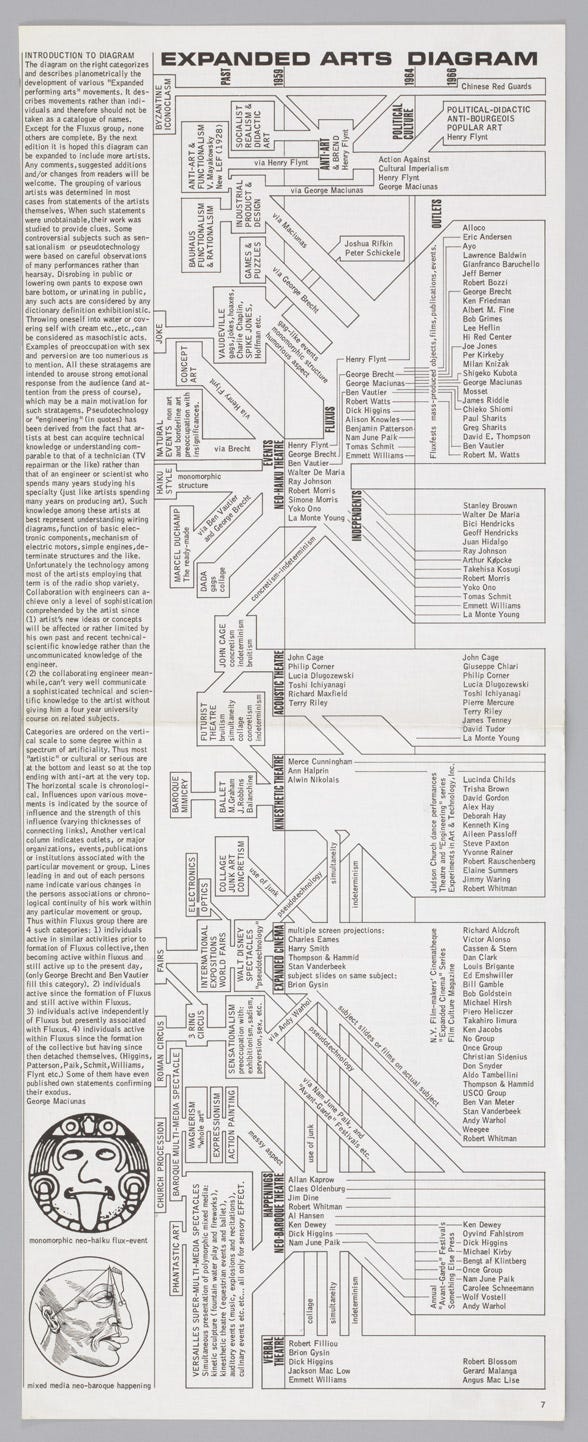
A lot more could be added, but it’s all just errant thoughts, really. Outward lectures, seminars or what have you could be arranged. Research projects could be commissioned by users for fees. Etc.
I have been asked by people, after recent Tweets and threads, to put an idea on paper, or something like that, and after a little time, this is what my thinking resulted in. Having written all this, I don't feel particularly eager to rush out and put these ideas into motion. Yet, perhaps simply designing something hypothetically like this, can simply serve as a demonstration. I have no idea if there is any value to it, and I personally don’t know what the solution is, but I suppose the effort to consider the matter may have some value in of itself.
Comments
Incredible piece, KB. It makes me long for a world with different incentive structures in place.
decaf24
2021-12-23 15:23:02 +0000 UTCThe shape of the institution you've described sounds an awful lot like a monastic order. Provide community, collaboration, mastery and culture to the inside... provide scholarship, example, and a product of value to the outside. Instead of cels its run by incels. Instead of copying books by hand all day they scan them.
4thbox
2020-08-11 19:22:22 +0000 UTC